


In a recent blog, I wrote about how to effectively say “no” around screen time and I promised to write more about accountability and consequences when rules are broken. Enforcing rules is by far one of the hardest things we do as parents, especially with teens. There is so little written that gives example consequences and yet getting ideas is so important as a parent. So after you read this, share what you do in the comments section below — that would be a real gift.
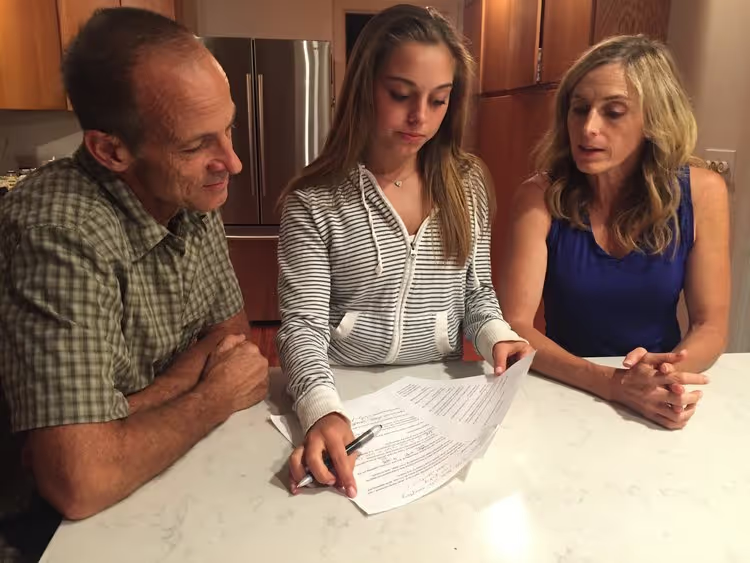
Knowing I would write this tonight, I decided to clarify with my daughter, Tessa (who is in Screenagers — and now in 11th grade), the consequences regarding the rules (that she helped create) around screen time at night. Sunday through Thursday night, at a time we agreed upon she hands my husband or me her phone, or she or she plugs it in to charge in the corner of my bedroom. The rule includes not using her computer for socializing after that time as well — i.e. no instant messaging or Instagram on the computer.
I asked her for ideas for consequences if she did not turn in the phone at the agreed upon time. Her first one was that if she breaks the rule she would not have access to her phone for the entire following day. I responded “really?” — with a tone that implied that maybe that would be too harsh. And then, she quickly came up with something a little less harsh, “I can’t bring it to school the next day.” We agreed that made sense.
Next, we started brainstorming ways she would succeed with the rule. I asked if she thought it would help her to put an alarm on her phone for the time she is supposed to put it in my room. She said, “Yep, that makes sense, I will set it for 5 minutes before to help remind me.”
Setting fair consequences, that our youth help set (when possible), is a gift we give our children. It is a lot easier to “check out” and just let kids and teens sort out for themselves what, when and how long they want to use screens. But, of course, that is not the solution. Frankly, that approach would prevent many kids from reaching short and long-term goals. In Screenagers we look at the research about how improving one’s self-control is a predictor of all sorts of positive outcomes later in life. Having a few key rules and practice following them does indeed strengthen executive functioning and self-control.
It is not just a politically correct idea that we involve youth in establishing their rules and consequences, I believe it is actually fundamental. As children become teens, having autonomy and feeling respected are increasingly important. Let them know how much you regard their input and that you understand they want control over their lives. Let them also know that a healthy home has screen time limits, period. It is just the way it is, research shows that this is extremely important.
A parent’s goal is to enforce a rule in a matter of fact way, staying calm. No lecturing, no yelling. This can be so hard, but it is worth it. This is all about decreasing power struggles. If a rule ultimately does not work, then find a time to discuss the issue — which is one of the main reasons that Tech Talk Tuesdays exists.
Rule: Phone gets handed over to a parent at 9 pm.
Predetermined Consequence> If not done, the next night a parent takes the phone at 8 pm. Then, the night after, go back to the original rule where the child hands it over at 9.
Rule: iPad (or another portable screen) is not to be in the bedroom, but to stay in the office or another family common space.
Predetermined Consequence> If brought into the bedroom, iPad is put away for the rest of the day and is not used the next day at all.
Rule: No video games on Monday, Tuesday and Wednesday.
Predefined Consequence> If found to be playing video games, they lose video game time for one day.
Rule: While doing homework, keep the phone in another room but can take phone breaks.
Predefined Consequence> If they are found with the phone by the computer while they work, then it gets put away for the rest of the day.
Rule: Parent gives a specific amount of time the child/teen can play a video game.
Predefined Consequence> If the child does not comply when the time is up, the time the child can play is shortened by 10 minutes the next scheduled video game play.
Rule: Not to use a personal device at a certain event, such as a family gathering.
Predefined Consequence> If uses a device at the event, they cannot use that device after the event and following morning.
Rule: No use of your phone in class. (You might only hear about this from a teacher or administrator.)
Predefined Consequence> If phone is being used, then it must stay home the next day. If it happens again, it would be for the week.
Rule: No internet or video games during the school week — if needs to check something on the internet, must ask a parent first.
Predefined Consequence> If found doing this during the week then they lose some of Saturday computer time.
Rule: The kitchen is a device-free zone in the house.
Predefined Consequence> When the child is on a device in the kitchen they get one warning, but the next time they lose the nighttime privilege of 20 minutes of screen time that day.
We would love for you to share this TTT any way that works for you, whether that’s on social media or via a newsletter. If you want to send it out in your newsletter we just ask that you credit us and link to our website, and let us know at lisa@screenagersmovie.com.
HOST A SCREENING to help spark change.
FIND EVENT LISTINGS
Stay in touch with the Screenagers community on Facebook, Twitter and at www.screenagersmovie.com.
Now Available for Educators: A New Professional Development Resource
Request more information about this 6-hour ready-to-use Professional Development module.


Learn more about showing our movies in your school or community!
Join Screenagers filmmaker Delaney Ruston MD for our latest Podcast

Learn more about our Screen-Free Sleep campaign at the website!
Our movie made for parents and educators of younger kids
Learn more about showing our movies in your school or community!
Register your interest in bringing our new movie to your school or community
Learn more about showing our movies in your school or community!
Join Screenagers filmmaker Delaney Ruston MD for our latest Podcast
Learn more about our Screen-Free Sleep campaign at the website!
Our movie made for parents and educators of younger kids
Join Screenagers filmmaker Delaney Ruston MD for our latest Podcast
Register your interest in bringing our new movie to your school or community

As we’re about to celebrate 10 years of Screenagers, we want to hear what’s been most helpful and what you’d like to see next.
Please click here to share your thoughts with us in our community survey. It only takes 5–10 minutes, and everyone who completes it will be entered to win one of five $50 Amazon vouchers.
In a recent blog, I wrote about how to effectively say “no” around screen time and I promised to write more about accountability and consequences when rules are broken. Enforcing rules is by far one of the hardest things we do as parents, especially with teens. There is so little written that gives example consequences and yet getting ideas is so important as a parent. So after you read this, share what you do in the comments section below — that would be a real gift.
Knowing I would write this tonight, I decided to clarify with my daughter, Tessa (who is in Screenagers — and now in 11th grade), the consequences regarding the rules (that she helped create) around screen time at night. Sunday through Thursday night, at a time we agreed upon she hands my husband or me her phone, or she or she plugs it in to charge in the corner of my bedroom. The rule includes not using her computer for socializing after that time as well — i.e. no instant messaging or Instagram on the computer.
I asked her for ideas for consequences if she did not turn in the phone at the agreed upon time. Her first one was that if she breaks the rule she would not have access to her phone for the entire following day. I responded “really?” — with a tone that implied that maybe that would be too harsh. And then, she quickly came up with something a little less harsh, “I can’t bring it to school the next day.” We agreed that made sense.
Next, we started brainstorming ways she would succeed with the rule. I asked if she thought it would help her to put an alarm on her phone for the time she is supposed to put it in my room. She said, “Yep, that makes sense, I will set it for 5 minutes before to help remind me.”
Setting fair consequences, that our youth help set (when possible), is a gift we give our children. It is a lot easier to “check out” and just let kids and teens sort out for themselves what, when and how long they want to use screens. But, of course, that is not the solution. Frankly, that approach would prevent many kids from reaching short and long-term goals. In Screenagers we look at the research about how improving one’s self-control is a predictor of all sorts of positive outcomes later in life. Having a few key rules and practice following them does indeed strengthen executive functioning and self-control.
It is not just a politically correct idea that we involve youth in establishing their rules and consequences, I believe it is actually fundamental. As children become teens, having autonomy and feeling respected are increasingly important. Let them know how much you regard their input and that you understand they want control over their lives. Let them also know that a healthy home has screen time limits, period. It is just the way it is, research shows that this is extremely important.
A parent’s goal is to enforce a rule in a matter of fact way, staying calm. No lecturing, no yelling. This can be so hard, but it is worth it. This is all about decreasing power struggles. If a rule ultimately does not work, then find a time to discuss the issue — which is one of the main reasons that Tech Talk Tuesdays exists.
Rule: Phone gets handed over to a parent at 9 pm.
Predetermined Consequence> If not done, the next night a parent takes the phone at 8 pm. Then, the night after, go back to the original rule where the child hands it over at 9.
Rule: iPad (or another portable screen) is not to be in the bedroom, but to stay in the office or another family common space.
Predetermined Consequence> If brought into the bedroom, iPad is put away for the rest of the day and is not used the next day at all.
Rule: No video games on Monday, Tuesday and Wednesday.
Predefined Consequence> If found to be playing video games, they lose video game time for one day.
Rule: While doing homework, keep the phone in another room but can take phone breaks.
Predefined Consequence> If they are found with the phone by the computer while they work, then it gets put away for the rest of the day.
Rule: Parent gives a specific amount of time the child/teen can play a video game.
Predefined Consequence> If the child does not comply when the time is up, the time the child can play is shortened by 10 minutes the next scheduled video game play.
Rule: Not to use a personal device at a certain event, such as a family gathering.
Predefined Consequence> If uses a device at the event, they cannot use that device after the event and following morning.
Rule: No use of your phone in class. (You might only hear about this from a teacher or administrator.)
Predefined Consequence> If phone is being used, then it must stay home the next day. If it happens again, it would be for the week.
Rule: No internet or video games during the school week — if needs to check something on the internet, must ask a parent first.
Predefined Consequence> If found doing this during the week then they lose some of Saturday computer time.
Rule: The kitchen is a device-free zone in the house.
Predefined Consequence> When the child is on a device in the kitchen they get one warning, but the next time they lose the nighttime privilege of 20 minutes of screen time that day.
We would love for you to share this TTT any way that works for you, whether that’s on social media or via a newsletter. If you want to send it out in your newsletter we just ask that you credit us and link to our website, and let us know at lisa@screenagersmovie.com.
HOST A SCREENING to help spark change.
FIND EVENT LISTINGS
Stay in touch with the Screenagers community on Facebook, Twitter and at www.screenagersmovie.com.
Now Available for Educators: A New Professional Development Resource
Request more information about this 6-hour ready-to-use Professional Development module.
Sign up here to receive the weekly Tech Talk Tuesdays newsletter from Screenagers filmmaker Delaney Ruston MD.
We respect your privacy.
In a recent blog, I wrote about how to effectively say “no” around screen time and I promised to write more about accountability and consequences when rules are broken. Enforcing rules is by far one of the hardest things we do as parents, especially with teens. There is so little written that gives example consequences and yet getting ideas is so important as a parent. So after you read this, share what you do in the comments section below — that would be a real gift.
Knowing I would write this tonight, I decided to clarify with my daughter, Tessa (who is in Screenagers — and now in 11th grade), the consequences regarding the rules (that she helped create) around screen time at night. Sunday through Thursday night, at a time we agreed upon she hands my husband or me her phone, or she or she plugs it in to charge in the corner of my bedroom. The rule includes not using her computer for socializing after that time as well — i.e. no instant messaging or Instagram on the computer.
I asked her for ideas for consequences if she did not turn in the phone at the agreed upon time. Her first one was that if she breaks the rule she would not have access to her phone for the entire following day. I responded “really?” — with a tone that implied that maybe that would be too harsh. And then, she quickly came up with something a little less harsh, “I can’t bring it to school the next day.” We agreed that made sense.
Next, we started brainstorming ways she would succeed with the rule. I asked if she thought it would help her to put an alarm on her phone for the time she is supposed to put it in my room. She said, “Yep, that makes sense, I will set it for 5 minutes before to help remind me.”
Setting fair consequences, that our youth help set (when possible), is a gift we give our children. It is a lot easier to “check out” and just let kids and teens sort out for themselves what, when and how long they want to use screens. But, of course, that is not the solution. Frankly, that approach would prevent many kids from reaching short and long-term goals. In Screenagers we look at the research about how improving one’s self-control is a predictor of all sorts of positive outcomes later in life. Having a few key rules and practice following them does indeed strengthen executive functioning and self-control.
It is not just a politically correct idea that we involve youth in establishing their rules and consequences, I believe it is actually fundamental. As children become teens, having autonomy and feeling respected are increasingly important. Let them know how much you regard their input and that you understand they want control over their lives. Let them also know that a healthy home has screen time limits, period. It is just the way it is, research shows that this is extremely important.
A parent’s goal is to enforce a rule in a matter of fact way, staying calm. No lecturing, no yelling. This can be so hard, but it is worth it. This is all about decreasing power struggles. If a rule ultimately does not work, then find a time to discuss the issue — which is one of the main reasons that Tech Talk Tuesdays exists.
Rule: Phone gets handed over to a parent at 9 pm.
Predetermined Consequence> If not done, the next night a parent takes the phone at 8 pm. Then, the night after, go back to the original rule where the child hands it over at 9.
Rule: iPad (or another portable screen) is not to be in the bedroom, but to stay in the office or another family common space.
Predetermined Consequence> If brought into the bedroom, iPad is put away for the rest of the day and is not used the next day at all.
Rule: No video games on Monday, Tuesday and Wednesday.
Predefined Consequence> If found to be playing video games, they lose video game time for one day.
Rule: While doing homework, keep the phone in another room but can take phone breaks.
Predefined Consequence> If they are found with the phone by the computer while they work, then it gets put away for the rest of the day.
Rule: Parent gives a specific amount of time the child/teen can play a video game.
Predefined Consequence> If the child does not comply when the time is up, the time the child can play is shortened by 10 minutes the next scheduled video game play.
Rule: Not to use a personal device at a certain event, such as a family gathering.
Predefined Consequence> If uses a device at the event, they cannot use that device after the event and following morning.
Rule: No use of your phone in class. (You might only hear about this from a teacher or administrator.)
Predefined Consequence> If phone is being used, then it must stay home the next day. If it happens again, it would be for the week.
Rule: No internet or video games during the school week — if needs to check something on the internet, must ask a parent first.
Predefined Consequence> If found doing this during the week then they lose some of Saturday computer time.
Rule: The kitchen is a device-free zone in the house.
Predefined Consequence> When the child is on a device in the kitchen they get one warning, but the next time they lose the nighttime privilege of 20 minutes of screen time that day.
We would love for you to share this TTT any way that works for you, whether that’s on social media or via a newsletter. If you want to send it out in your newsletter we just ask that you credit us and link to our website, and let us know at lisa@screenagersmovie.com.
HOST A SCREENING to help spark change.
FIND EVENT LISTINGS
Stay in touch with the Screenagers community on Facebook, Twitter and at www.screenagersmovie.com.
Now Available for Educators: A New Professional Development Resource
Request more information about this 6-hour ready-to-use Professional Development module.

I've been noticing the ways I can be rude, in person and on my phone. This week I share two recent examples of my own, plus why correcting myself out loud strengthens self-awareness. The talk that follows isn't about your kid. It's about you going first.
READ MORE >
An Oakland library has started lending out sports equipment and games alongside books, so families can borrow gear to use at nearby parks. It is a reminder that borrowing and lending between families is a simple way to fill a summer afternoon without a screen, while quietly modelling generosity and humility. We are out of practice at asking, but the person on the other end is usually glad to help.
READ MORE >
E-readers are convenient, but there are three reasons to lean toward paper books this summer. First, e-readers are screens, and the pull of everything else you could do on one makes it harder to stay immersed. Second, a large meta-analysis found people understand and remember slightly better on paper, especially with longer texts. Third, easy access to endless book samples makes it too tempting to jump ship rather than work through the slower parts, since reading, unlike TikTok, is about delayed gratification.
READ MORE >for more like this, DR. DELANEY RUSTON'S NEW BOOK, PARENTING IN THE SCREEN AGE, IS THE DEFINITIVE GUIDE FOR TODAY’S PARENTS. WITH INSIGHTS ON SCREEN TIME FROM RESEARCHERS, INPUT FROM KIDS & TEENS, THIS BOOK IS PACKED WITH SOLUTIONS FOR HOW TO START AND SUSTAIN PRODUCTIVE FAMILY TALKS ABOUT TECHNOLOGY AND IT’S IMPACT ON OUR MENTAL WELLBEING.