



AI makes schoolwork easier to bypass, at a time when many students already feel disengaged and far less motivated than parents assume. New data shows big gaps between what parents think their kids experience and how students actually feel about interest and belonging. The Brookings framework describes four modes of engagement, from resisting to exploring, and parents can help kids spend more time in Explorer mode by supporting autonomy, encouraging metacognitive reflection, nurturing interests outside school, and sharing learning experiences that spark curiosity.
As I write today’s blog, my daughter Tessa is sitting in front of me doing her homework. She just started a master’s program to become an elementary school teacher. She is very excited about this, and I couldn’t be happier about her choosing this path.
What I am thinking about at this moment is how Tessa is choosing to use AI in her learning. How will her future students?
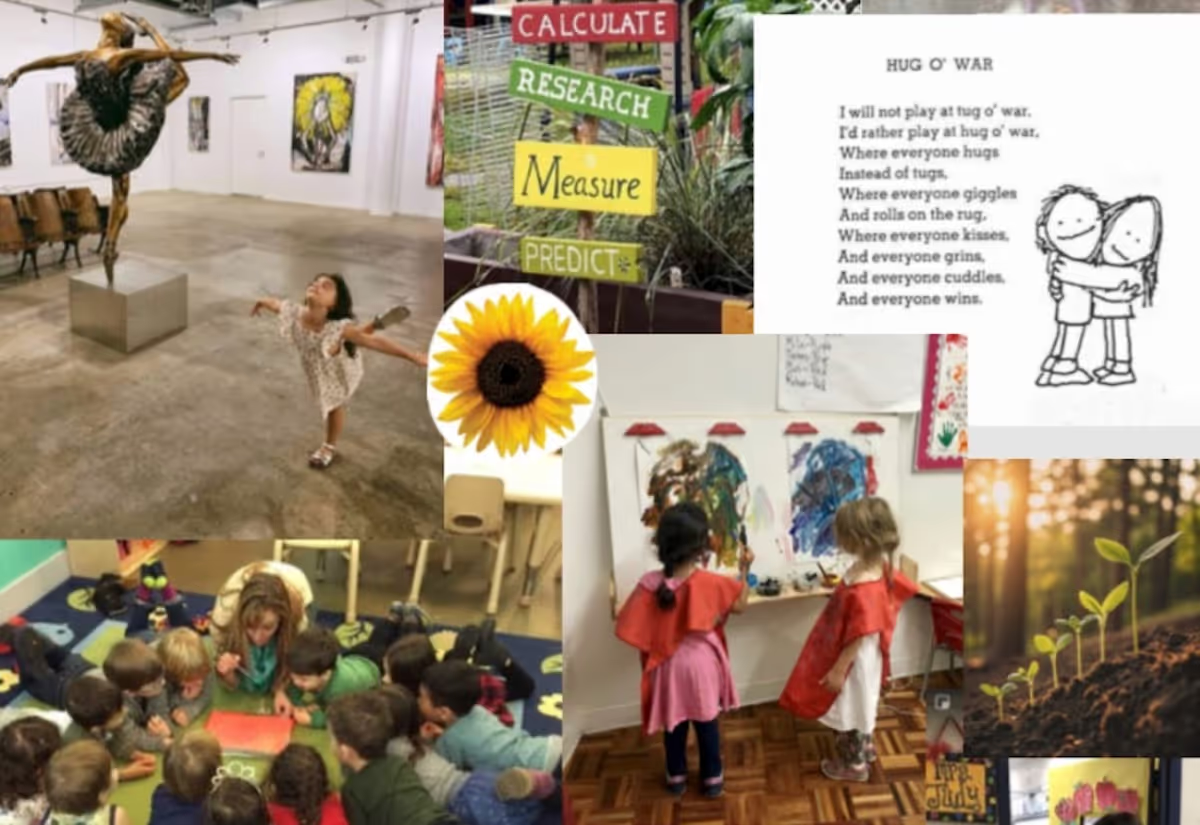
This second Tessa shows me her poem, which she just wrote, and a vision board she created (today’s graphic). My first question was, “Did you use chat to help write the poem?” She said, “No, but I did think about that option.”
I must confess, I was happy she said no, but like all of us, she will use AI at times, and many times, rightly so.
(*By the way, she said I could share her poem, and if you are interested, you can find it at the end of this blog.)
We want our kids to be motivated to learn, face challenges, and generate their own ideas. However, school often assigns work that doesn't inspire interest, and now AI provides an easy shortcut. Instead of struggling through it, students can simply ask a chatbot for answers or even complete assignments.
I will share new data and a framework that explains what is happening, along with five ways parents can help kids stay engaged in learning.


Learn more about showing our movies in your school or community!
Join Screenagers filmmaker Delaney Ruston MD for our latest Podcast

Learn more about our Screen-Free Sleep campaign at the website!
Our movie made for parents and educators of younger kids
Learn more about showing our movies in your school or community!
Register your interest in bringing our new movie to your school or community
This year, the Brookings Institution, which I hold in high regard, released a fascinating new report titled The Disengagement Gap: Why Student Engagement Isn’t What Parents Expect. The report was led by researcher Rebecca Winthrop.
The study surveyed 65,000 students in grades 3–12 and nearly 2,000 parents.
A couple of key findings:
The point is that we parents often make assumptions that don't align with our kids’ experiences.
The report explains that motivation is the internal drive for learning, while engagement reflects how that drive manifests in students’ actions, thoughts, feelings, and initiative. The authors describe four patterns of engagement that students may switch between depending on the types of learning settings and experiences they encounter.
Adopt an autonomy-supportive approach. Be really respectful and excited about the areas that your child naturally cares about.
Why it works: When kids feel a sense of choice and ownership, they engage more deeply rather than simply complying.
Strengthen self-awareness through metacognitive questions. Ask questions like “How do you stay focused when things feel distracting?” or “What helps you calm down before a big test?” rather than rushing to solve problems for them.
Why it works: Reflecting on how they learn builds agency and helps them direct their own growth.
Support their interests outside school. Show curiosity in what excites your child, whether it is a hobby, sport, or online project, and help them find ways to challenge themselves in those areas.
Why it works: When passions are validated, kids feel seen and are more likely to bring that energy back into their academic life.
Share experiences to spark curiosity together. Read a book alongside your child, visit a museum, or explore a topic together and talk about what stood out to each of you.
Why it works: Shared learning strengthens connection and models curiosity as something valuable in everyday life.
*Tessa’s poem for her homework assignment, which was to do a journal entry about “My Teacher Pedagogy.”
My Nonna once sat me down and gifted me a list of games to use with the kids I babysat.
Like a lot of my family, she took great pride in being an educator.
The list ranged from naming all the sounds we could hear to pretending to play tug-of-war with a rope made of imaginary materials.
I don't want to be simply a "teacher", I want to be a life-long learner who inspires children to be one too.
Our future will be molded by listening, imagining, and fighting for a society far less shattered than today's.
I teach for my Nonna and my Great-Nonna.
I teach for my kids and your great-grandkids.
I teach for yesterday, today, and for a day we cannot yet picture.
Dreaming is a good start.
September 5, 2025
Learn more about showing our movies in your school or community!
Join Screenagers filmmaker Delaney Ruston MD for our latest Podcast
Learn more about our Screen-Free Sleep campaign at the website!
Our movie made for parents and educators of younger kids
Join Screenagers filmmaker Delaney Ruston MD for our latest Podcast
Register your interest in bringing our new movie to your school or community
Be sure to subscribe to our YouTube Channel! We add new videos regularly and you'll find over 100 videos covering parenting advice, guidance, podcasts, movie clips and more. Here's our most recent:

As we’re about to celebrate 10 years of Screenagers, we want to hear what’s been most helpful and what you’d like to see next.
Please click here to share your thoughts with us in our community survey. It only takes 5–10 minutes, and everyone who completes it will be entered to win one of five $50 Amazon vouchers.
As I write today’s blog, my daughter Tessa is sitting in front of me doing her homework. She just started a master’s program to become an elementary school teacher. She is very excited about this, and I couldn’t be happier about her choosing this path.
What I am thinking about at this moment is how Tessa is choosing to use AI in her learning. How will her future students?
This second Tessa shows me her poem, which she just wrote, and a vision board she created (today’s graphic). My first question was, “Did you use chat to help write the poem?” She said, “No, but I did think about that option.”
I must confess, I was happy she said no, but like all of us, she will use AI at times, and many times, rightly so.
(*By the way, she said I could share her poem, and if you are interested, you can find it at the end of this blog.)
We want our kids to be motivated to learn, face challenges, and generate their own ideas. However, school often assigns work that doesn't inspire interest, and now AI provides an easy shortcut. Instead of struggling through it, students can simply ask a chatbot for answers or even complete assignments.
I will share new data and a framework that explains what is happening, along with five ways parents can help kids stay engaged in learning.
This year, the Brookings Institution, which I hold in high regard, released a fascinating new report titled The Disengagement Gap: Why Student Engagement Isn’t What Parents Expect. The report was led by researcher Rebecca Winthrop.
The study surveyed 65,000 students in grades 3–12 and nearly 2,000 parents.
A couple of key findings:
The point is that we parents often make assumptions that don't align with our kids’ experiences.
The report explains that motivation is the internal drive for learning, while engagement reflects how that drive manifests in students’ actions, thoughts, feelings, and initiative. The authors describe four patterns of engagement that students may switch between depending on the types of learning settings and experiences they encounter.
Adopt an autonomy-supportive approach. Be really respectful and excited about the areas that your child naturally cares about.
Why it works: When kids feel a sense of choice and ownership, they engage more deeply rather than simply complying.
Strengthen self-awareness through metacognitive questions. Ask questions like “How do you stay focused when things feel distracting?” or “What helps you calm down before a big test?” rather than rushing to solve problems for them.
Why it works: Reflecting on how they learn builds agency and helps them direct their own growth.
Support their interests outside school. Show curiosity in what excites your child, whether it is a hobby, sport, or online project, and help them find ways to challenge themselves in those areas.
Why it works: When passions are validated, kids feel seen and are more likely to bring that energy back into their academic life.
Share experiences to spark curiosity together. Read a book alongside your child, visit a museum, or explore a topic together and talk about what stood out to each of you.
Why it works: Shared learning strengthens connection and models curiosity as something valuable in everyday life.
*Tessa’s poem for her homework assignment, which was to do a journal entry about “My Teacher Pedagogy.”
My Nonna once sat me down and gifted me a list of games to use with the kids I babysat.
Like a lot of my family, she took great pride in being an educator.
The list ranged from naming all the sounds we could hear to pretending to play tug-of-war with a rope made of imaginary materials.
I don't want to be simply a "teacher", I want to be a life-long learner who inspires children to be one too.
Our future will be molded by listening, imagining, and fighting for a society far less shattered than today's.
I teach for my Nonna and my Great-Nonna.
I teach for my kids and your great-grandkids.
I teach for yesterday, today, and for a day we cannot yet picture.
Dreaming is a good start.
September 5, 2025
Be sure to subscribe to our YouTube Channel! We add new videos regularly and you'll find over 100 videos covering parenting advice, guidance, podcasts, movie clips and more. Here's our most recent:
Sign up here to receive the weekly Tech Talk Tuesdays newsletter from Screenagers filmmaker Delaney Ruston MD.
We respect your privacy.
As I write today’s blog, my daughter Tessa is sitting in front of me doing her homework. She just started a master’s program to become an elementary school teacher. She is very excited about this, and I couldn’t be happier about her choosing this path.
What I am thinking about at this moment is how Tessa is choosing to use AI in her learning. How will her future students?
This second Tessa shows me her poem, which she just wrote, and a vision board she created (today’s graphic). My first question was, “Did you use chat to help write the poem?” She said, “No, but I did think about that option.”
I must confess, I was happy she said no, but like all of us, she will use AI at times, and many times, rightly so.
(*By the way, she said I could share her poem, and if you are interested, you can find it at the end of this blog.)
We want our kids to be motivated to learn, face challenges, and generate their own ideas. However, school often assigns work that doesn't inspire interest, and now AI provides an easy shortcut. Instead of struggling through it, students can simply ask a chatbot for answers or even complete assignments.
I will share new data and a framework that explains what is happening, along with five ways parents can help kids stay engaged in learning.

Adam's Law was signed in California last week, named for Adam Raine, the 16-year-old who died by suicide in April 2025 after months of conversations with ChatGPT. It bars companion chatbots from encouraging self-harm, claiming to be human, simulating romantic interest in children, or claiming a special understanding of a child. That last group of protections particularly gets my attention. The good news is that people care deeply and are working hard to put guardrails in place, but we can't assume it's all resolved, because it isn't.
READ MORE >
Elliston Berry was 14 when a classmate used a nudify app to turn one of her Instagram photos into a fake nude that spread through her school. Almost one in five teens has made AI sexual content or knows someone who has. In our new film, Elliston and her mom Anna explain how they went from that morning to helping pass a federal law, the Take It Down Act.
READ MORE >
Google's AI answers now appear in search results whether anyone asks for them or not, and nobody can turn them off. A new Common Sense Media study using pretend child accounts found those answers repeatedly failed young people in crisis... Today's quiz walks through the findings, and you can take it with your kids to spark a meaningful conversation about AI.
READ MORE >for more like this, DR. DELANEY RUSTON'S NEW BOOK, PARENTING IN THE SCREEN AGE, IS THE DEFINITIVE GUIDE FOR TODAY’S PARENTS. WITH INSIGHTS ON SCREEN TIME FROM RESEARCHERS, INPUT FROM KIDS & TEENS, THIS BOOK IS PACKED WITH SOLUTIONS FOR HOW TO START AND SUSTAIN PRODUCTIVE FAMILY TALKS ABOUT TECHNOLOGY AND IT’S IMPACT ON OUR MENTAL WELLBEING.