

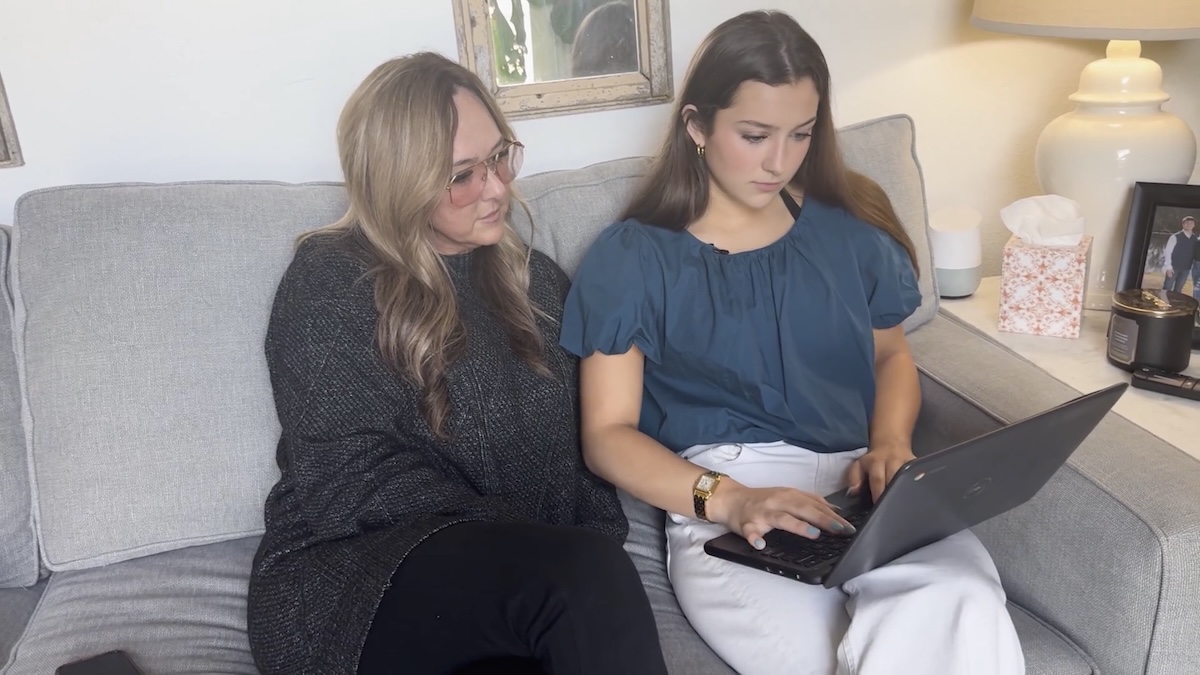

Elliston Berry was 14 when a classmate used a nudify app to turn one of her Instagram photos into a fake nude that spread through her school. Almost one in five teens has made AI sexual content or knows someone who has. In our new film, Elliston and her mom Anna explain how they went from that morning to helping pass a federal law, the Take It Down Act.
Imagine this. It's a typical Monday morning at school, and you hear your 14-year-old daughter bawling in the other room.
Before you even have time to respond, she races through your door, holding her phone and showing you a nude image of herself that her friend had sent to her over text. An image that she had not taken, posed in a scene that had never occurred.
She doesn’t know how her friend got this picture but points out a similar picture of herself, on her Instagram account with clothes on. This was a disturbingly realistic, but fake, AI generated image.
This is precisely what happened to Elliston Berry when she was 14.
In our new film Screenagers Generation AI (which launches Sept 8th), Elliston and her mom, Anna, explain the whole saga, from that horrible morning, right through to the very end when they helped get a historic law passed.
According to a report from Common Sense Media, About 1 in 5 teens (18%) has made AI sexual content, or knows someone who has. About 1 in 4 (25%) has shared this kind of content or knows someone who has.
This type of AI sexual content is called a deepfake. This is a specific type of fake media, often created with the help of AI. According to Merriam-Webster, it is “a digital image, video, voice, etc. that has been convincingly generated or altered to misrepresent someone as doing or saying something that was not actually done or said.”
You can see Elliston and her mom in the trailer of Screenagers: Generation AI here:
Elliston was completely shocked to see that a friend had texted her a naked picture of her. She went to school, and was consoled by her friends over what had happened. Elliston was worried that the photo could be all over social media. Sadly, the picture had been widely shared, particularly via Snapchat.


Learn more about showing our movies in your school or community!
Join Screenagers filmmaker Delaney Ruston MD for our latest Podcast

Learn more about our Screen-Free Sleep campaign at the website!
Our movie made for parents and educators of younger kids
Learn more about showing our movies in your school or community!
Register your interest in bringing our new movie to your school or community
Very soon it became apparent that whoever did this had also targeted eight other girls at the school.
It took some time, but eventually a male classmate was identified as the creator of the deepfakes.
He had used what is known as a nudify app. An AI app designed to alter real images, with the specific ability to strip away clothing from the subject.
In the film, Riana Pfefferkorn, JD, a researcher at the Stanford Institute for Human Centered AI, says:
"Nudify apps, they don't advertise themselves as non-consensual deepfake pornography machines. They advertise themselves with something more innocuous, [like] doing a face swap or making it look like two people are kissing, something that doesn't necessarily run afoul of App Store policies."
Following their experience with this, Elliston and her mom campaigned to bring about changes in the law to protect others. Their efforts played a part in helping pass the Take It Down Act which was signed into law on May 19, 2025, and took effect May 19, 2026, and also helped inspire similar changes in other countries.
In Screenagers: Generation AI, Anna explains;
"The Take It Down Act is a requirement by Big Tech that they have 48 hours to take down any images that are requested to be taken down."
Elliston has continued her advocacy efforts and has helped create an online training course to teach students, parents and school staff about non-consensual, explicit deepfake image abuse.
It is early days with the Take It Down Act, but we can only hope that big tech will strictly comply with the new law, and this goes someway to making the lives of young people free of the sort of experience Elliston, her classmates, and many others have sadly had to go through.
Learn more about showing our movies in your school or community!
Join Screenagers filmmaker Delaney Ruston MD for our latest Podcast
Learn more about our Screen-Free Sleep campaign at the website!
Our movie made for parents and educators of younger kids
Join Screenagers filmmaker Delaney Ruston MD for our latest Podcast
Register your interest in bringing our new movie to your school or community
Subscribe to our YouTube Channel! We add new videos regularly and you'll find over 100 videos covering parenting advice, guidance, podcasts, movie clips and more. Here's our most recent:

As we’re about to celebrate 10 years of Screenagers, we want to hear what’s been most helpful and what you’d like to see next.
Please click here to share your thoughts with us in our community survey. It only takes 5–10 minutes, and everyone who completes it will be entered to win one of five $50 Amazon vouchers.
Imagine this. It's a typical Monday morning at school, and you hear your 14-year-old daughter bawling in the other room.
Before you even have time to respond, she races through your door, holding her phone and showing you a nude image of herself that her friend had sent to her over text. An image that she had not taken, posed in a scene that had never occurred.
She doesn’t know how her friend got this picture but points out a similar picture of herself, on her Instagram account with clothes on. This was a disturbingly realistic, but fake, AI generated image.
This is precisely what happened to Elliston Berry when she was 14.
In our new film Screenagers Generation AI (which launches Sept 8th), Elliston and her mom, Anna, explain the whole saga, from that horrible morning, right through to the very end when they helped get a historic law passed.
According to a report from Common Sense Media, About 1 in 5 teens (18%) has made AI sexual content, or knows someone who has. About 1 in 4 (25%) has shared this kind of content or knows someone who has.
This type of AI sexual content is called a deepfake. This is a specific type of fake media, often created with the help of AI. According to Merriam-Webster, it is “a digital image, video, voice, etc. that has been convincingly generated or altered to misrepresent someone as doing or saying something that was not actually done or said.”
You can see Elliston and her mom in the trailer of Screenagers: Generation AI here:
Elliston was completely shocked to see that a friend had texted her a naked picture of her. She went to school, and was consoled by her friends over what had happened. Elliston was worried that the photo could be all over social media. Sadly, the picture had been widely shared, particularly via Snapchat.
Very soon it became apparent that whoever did this had also targeted eight other girls at the school.
It took some time, but eventually a male classmate was identified as the creator of the deepfakes.
He had used what is known as a nudify app. An AI app designed to alter real images, with the specific ability to strip away clothing from the subject.
In the film, Riana Pfefferkorn, JD, a researcher at the Stanford Institute for Human Centered AI, says:
"Nudify apps, they don't advertise themselves as non-consensual deepfake pornography machines. They advertise themselves with something more innocuous, [like] doing a face swap or making it look like two people are kissing, something that doesn't necessarily run afoul of App Store policies."
Following their experience with this, Elliston and her mom campaigned to bring about changes in the law to protect others. Their efforts played a part in helping pass the Take It Down Act which was signed into law on May 19, 2025, and took effect May 19, 2026, and also helped inspire similar changes in other countries.
In Screenagers: Generation AI, Anna explains;
"The Take It Down Act is a requirement by Big Tech that they have 48 hours to take down any images that are requested to be taken down."
Elliston has continued her advocacy efforts and has helped create an online training course to teach students, parents and school staff about non-consensual, explicit deepfake image abuse.
It is early days with the Take It Down Act, but we can only hope that big tech will strictly comply with the new law, and this goes someway to making the lives of young people free of the sort of experience Elliston, her classmates, and many others have sadly had to go through.
Subscribe to our YouTube Channel! We add new videos regularly and you'll find over 100 videos covering parenting advice, guidance, podcasts, movie clips and more. Here's our most recent:
Sign up here to receive the weekly Tech Talk Tuesdays newsletter from Screenagers filmmaker Delaney Ruston MD.
We respect your privacy.
Imagine this. It's a typical Monday morning at school, and you hear your 14-year-old daughter bawling in the other room.
Before you even have time to respond, she races through your door, holding her phone and showing you a nude image of herself that her friend had sent to her over text. An image that she had not taken, posed in a scene that had never occurred.
She doesn’t know how her friend got this picture but points out a similar picture of herself, on her Instagram account with clothes on. This was a disturbingly realistic, but fake, AI generated image.
This is precisely what happened to Elliston Berry when she was 14.
In our new film Screenagers Generation AI (which launches Sept 8th), Elliston and her mom, Anna, explain the whole saga, from that horrible morning, right through to the very end when they helped get a historic law passed.
According to a report from Common Sense Media, About 1 in 5 teens (18%) has made AI sexual content, or knows someone who has. About 1 in 4 (25%) has shared this kind of content or knows someone who has.
This type of AI sexual content is called a deepfake. This is a specific type of fake media, often created with the help of AI. According to Merriam-Webster, it is “a digital image, video, voice, etc. that has been convincingly generated or altered to misrepresent someone as doing or saying something that was not actually done or said.”
You can see Elliston and her mom in the trailer of Screenagers: Generation AI here:
Elliston was completely shocked to see that a friend had texted her a naked picture of her. She went to school, and was consoled by her friends over what had happened. Elliston was worried that the photo could be all over social media. Sadly, the picture had been widely shared, particularly via Snapchat.
Adam's Law was signed in California last week, named for Adam Raine, the 16-year-old who died by suicide in April 2025 after months of conversations with ChatGPT. It bars companion chatbots from encouraging self-harm, claiming to be human, simulating romantic interest in children, or claiming a special understanding of a child. That last group of protections particularly gets my attention. The good news is that people care deeply and are working hard to put guardrails in place, but we can't assume it's all resolved, because it isn't.
READ MORE >
Google's AI answers now appear in search results whether anyone asks for them or not, and nobody can turn them off. A new Common Sense Media study using pretend child accounts found those answers repeatedly failed young people in crisis... Today's quiz walks through the findings, and you can take it with your kids to spark a meaningful conversation about AI.
READ MORE >
AI has moved into kids' lives faster than most parents can track, and this roundup gathers seven recent posts to help make sense of it: the AI now baked into the apps and devices kids already use, what happens when they turn to it for connection and support, and how it is reshaping the classroom.
READ MORE >for more like this, DR. DELANEY RUSTON'S NEW BOOK, PARENTING IN THE SCREEN AGE, IS THE DEFINITIVE GUIDE FOR TODAY’S PARENTS. WITH INSIGHTS ON SCREEN TIME FROM RESEARCHERS, INPUT FROM KIDS & TEENS, THIS BOOK IS PACKED WITH SOLUTIONS FOR HOW TO START AND SUSTAIN PRODUCTIVE FAMILY TALKS ABOUT TECHNOLOGY AND IT’S IMPACT ON OUR MENTAL WELLBEING.