



Parents often feel guilt or hypocrisy around their tech habits, something I’ve experienced too, like when Tessa told me I seemed distracted while she was talking. I’ve found it helpful to pause and ask: Is this guilt warranted? And am I living in line with my intentions? Sometimes adults and kids have different tech rules for valid reasons, and other times we’re simply inconsistent, like checking phones at dinner. The challenge is teasing apart when guilt or hypocrisy makes sense and when it doesn’t.
Let me cut to the chase. I hear from parents all the time that they feel hypocritical or guilty about their own phone or tech use vis-à-vis their kids.
In fact, those emotions were part of the reason the three parents I’ve been working with on my podcast wanted to change their tech habits. The final episode in that series was released yesterday, and we hear how each of them did. (Spoiler alert: it wasn’t all rosy.)
Recently, I’ve also been hearing from adults and school administrators who feel it’s hypocritical to tell kids they shouldn’t use AI tools like ChatGPT when adults use them regularly. (That will be the topic of a later blog post.)
However, the biggest hypocrisy issue I hear about is this: parents keep their devices in their bedrooms at night, but ask their kids not to. Is that fair? Is that hypocritical?
Then there’s guilt. Let me share an example from my parenting.
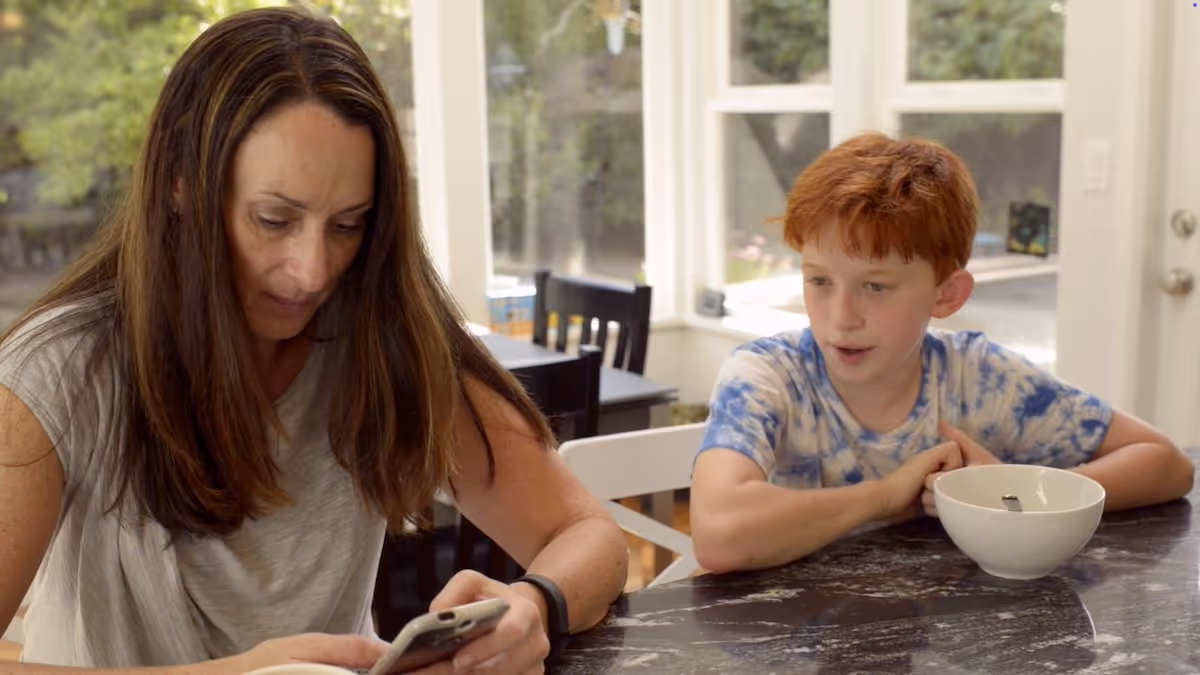
There’s a moment at the end of Screenagers: Growing Up in the Digital Age when my daughter Tessa tells me that when she comes into my office to talk, I seem distracted. Implied in her words is that I’m not giving her the attention she wants, I’m ignoring her. Who wants to be told by their child that they’re ignoring them?

Did I feel guilty at that moment? Yes. In the voice-over, you hear me say, “Tessa is right. I do need to be more mindful of how I’m using my tech.”
When I feel guilt around my tech use, I ask myself two questions. You may find these helpful too:
To answer the first question, I think about the meaning of guilt as doing something, i.e., a behavior, that is out of line with my goals or values that causes harm, big or small, to myself or someone else. That harm might be something minor (putting a questionable recyclable item in the recycling bin) or something more obvious, like cutting in line.


Learn more about showing our movies in your school or community!
Join Screenagers filmmaker Delaney Ruston MD for our latest Podcast

Learn more about our Screen-Free Sleep campaign at the website!
Our movie made for parents and educators of younger kids
Learn more about showing our movies in your school or community!
Register your interest in bringing our new movie to your school or community
There are many ways to think about the meaning of guilt.
For a more standard definition, Merriam-Webster’s dictionary offers a good starting point. For a more nuanced and deeper dive into guilt, Brené Brown offers a wonderful exploration in Atlas Of The Heart.
Yes, a bit. Working at night meant I was sometimes less available to Tessa than I wanted to be. That’s technoference, technology interfering with connection.
My intention is not to overdo work, which at home is basically always on a screen (or a call), especially when it cuts into family time or other important parts of life.
I’m not alone in this. Interestingly, more than half of teens notice phone distraction. According to a 2023 Pew Research Center survey of U.S. teens and their parents, 46% of teens report that their parents are at least sometimes distracted by their phone when the teen is trying to talk to them.
The Merriam-Webster dictionary defines hypocrisy as a “feigning to be what one is not or to believe what one does not: behavior that contradicts what one claims to believe or feel.”
In the context of parenting, hypocrisy often shows up when an adult forbids a child from doing something the adult does themselves.
At the same time, there are many things in life that adults are allowed to do but children and teens are not, and for good, logical reasons.
Driving, drinking alcohol, or smoking cannabis, staying up later, or climbing specific structures or mountains are all age-dependent privileges that come with safety and developmental considerations.

Still, sometimes the feeling of hypocrisy is absolutely warranted. For example, a family rule says no phones at the dining table, yet a parent often scrolls through sports or plays a game during dinner.
But other times, it isn’t warranted.
If a parent is rarely on their phone but has to quickly respond to a work or family emergency during a meal, that’s not hypocrisy.
The key is living life out loud, explaining why you’re using your phone at that moment so it doesn’t feel arbitrary or inconsistent.
And when it comes to devices in parents’ bedrooms versus kids’ bedrooms, we talk through our reasoning on the pushback page at screenfreesleep.org.
Learn more about showing our movies in your school or community!
Join Screenagers filmmaker Delaney Ruston MD for our latest Podcast
Learn more about our Screen-Free Sleep campaign at the website!
Our movie made for parents and educators of younger kids
Join Screenagers filmmaker Delaney Ruston MD for our latest Podcast
Register your interest in bringing our new movie to your school or community
Subscribe to our YouTube Channel! We add new videos regularly and you'll find over 100 videos covering parenting advice, guidance, podcasts, movie clips and more. Here's our most recent:

As we’re about to celebrate 10 years of Screenagers, we want to hear what’s been most helpful and what you’d like to see next.
Please click here to share your thoughts with us in our community survey. It only takes 5–10 minutes, and everyone who completes it will be entered to win one of five $50 Amazon vouchers.
Let me cut to the chase. I hear from parents all the time that they feel hypocritical or guilty about their own phone or tech use vis-à-vis their kids.
In fact, those emotions were part of the reason the three parents I’ve been working with on my podcast wanted to change their tech habits. The final episode in that series was released yesterday, and we hear how each of them did. (Spoiler alert: it wasn’t all rosy.)
Recently, I’ve also been hearing from adults and school administrators who feel it’s hypocritical to tell kids they shouldn’t use AI tools like ChatGPT when adults use them regularly. (That will be the topic of a later blog post.)
However, the biggest hypocrisy issue I hear about is this: parents keep their devices in their bedrooms at night, but ask their kids not to. Is that fair? Is that hypocritical?
Then there’s guilt. Let me share an example from my parenting.
There’s a moment at the end of Screenagers: Growing Up in the Digital Age when my daughter Tessa tells me that when she comes into my office to talk, I seem distracted. Implied in her words is that I’m not giving her the attention she wants, I’m ignoring her. Who wants to be told by their child that they’re ignoring them?
Did I feel guilty at that moment? Yes. In the voice-over, you hear me say, “Tessa is right. I do need to be more mindful of how I’m using my tech.”
When I feel guilt around my tech use, I ask myself two questions. You may find these helpful too:
To answer the first question, I think about the meaning of guilt as doing something, i.e., a behavior, that is out of line with my goals or values that causes harm, big or small, to myself or someone else. That harm might be something minor (putting a questionable recyclable item in the recycling bin) or something more obvious, like cutting in line.
There are many ways to think about the meaning of guilt.
For a more standard definition, Merriam-Webster’s dictionary offers a good starting point. For a more nuanced and deeper dive into guilt, Brené Brown offers a wonderful exploration in Atlas Of The Heart.
Yes, a bit. Working at night meant I was sometimes less available to Tessa than I wanted to be. That’s technoference, technology interfering with connection.
My intention is not to overdo work, which at home is basically always on a screen (or a call), especially when it cuts into family time or other important parts of life.
I’m not alone in this. Interestingly, more than half of teens notice phone distraction. According to a 2023 Pew Research Center survey of U.S. teens and their parents, 46% of teens report that their parents are at least sometimes distracted by their phone when the teen is trying to talk to them.
The Merriam-Webster dictionary defines hypocrisy as a “feigning to be what one is not or to believe what one does not: behavior that contradicts what one claims to believe or feel.”
In the context of parenting, hypocrisy often shows up when an adult forbids a child from doing something the adult does themselves.
At the same time, there are many things in life that adults are allowed to do but children and teens are not, and for good, logical reasons.
Driving, drinking alcohol, or smoking cannabis, staying up later, or climbing specific structures or mountains are all age-dependent privileges that come with safety and developmental considerations.
Still, sometimes the feeling of hypocrisy is absolutely warranted. For example, a family rule says no phones at the dining table, yet a parent often scrolls through sports or plays a game during dinner.
But other times, it isn’t warranted.
If a parent is rarely on their phone but has to quickly respond to a work or family emergency during a meal, that’s not hypocrisy.
The key is living life out loud, explaining why you’re using your phone at that moment so it doesn’t feel arbitrary or inconsistent.
And when it comes to devices in parents’ bedrooms versus kids’ bedrooms, we talk through our reasoning on the pushback page at screenfreesleep.org.
Subscribe to our YouTube Channel! We add new videos regularly and you'll find over 100 videos covering parenting advice, guidance, podcasts, movie clips and more. Here's our most recent:
Sign up here to receive the weekly Tech Talk Tuesdays newsletter from Screenagers filmmaker Delaney Ruston MD.
We respect your privacy.
Let me cut to the chase. I hear from parents all the time that they feel hypocritical or guilty about their own phone or tech use vis-à-vis their kids.
In fact, those emotions were part of the reason the three parents I’ve been working with on my podcast wanted to change their tech habits. The final episode in that series was released yesterday, and we hear how each of them did. (Spoiler alert: it wasn’t all rosy.)
Recently, I’ve also been hearing from adults and school administrators who feel it’s hypocritical to tell kids they shouldn’t use AI tools like ChatGPT when adults use them regularly. (That will be the topic of a later blog post.)
However, the biggest hypocrisy issue I hear about is this: parents keep their devices in their bedrooms at night, but ask their kids not to. Is that fair? Is that hypocritical?
Then there’s guilt. Let me share an example from my parenting.
There’s a moment at the end of Screenagers: Growing Up in the Digital Age when my daughter Tessa tells me that when she comes into my office to talk, I seem distracted. Implied in her words is that I’m not giving her the attention she wants, I’m ignoring her. Who wants to be told by their child that they’re ignoring them?
Did I feel guilty at that moment? Yes. In the voice-over, you hear me say, “Tessa is right. I do need to be more mindful of how I’m using my tech.”
When I feel guilt around my tech use, I ask myself two questions. You may find these helpful too:
To answer the first question, I think about the meaning of guilt as doing something, i.e., a behavior, that is out of line with my goals or values that causes harm, big or small, to myself or someone else. That harm might be something minor (putting a questionable recyclable item in the recycling bin) or something more obvious, like cutting in line.

I've been noticing the ways I can be rude, in person and on my phone. This week I share two recent examples of my own, plus why correcting myself out loud strengthens self-awareness. The talk that follows isn't about your kid. It's about you going first.
READ MORE >
An Oakland library has started lending out sports equipment and games alongside books, so families can borrow gear to use at nearby parks. It is a reminder that borrowing and lending between families is a simple way to fill a summer afternoon without a screen, while quietly modelling generosity and humility. We are out of practice at asking, but the person on the other end is usually glad to help.
READ MORE >
E-readers are convenient, but there are three reasons to lean toward paper books this summer. First, e-readers are screens, and the pull of everything else you could do on one makes it harder to stay immersed. Second, a large meta-analysis found people understand and remember slightly better on paper, especially with longer texts. Third, easy access to endless book samples makes it too tempting to jump ship rather than work through the slower parts, since reading, unlike TikTok, is about delayed gratification.
READ MORE >for more like this, DR. DELANEY RUSTON'S NEW BOOK, PARENTING IN THE SCREEN AGE, IS THE DEFINITIVE GUIDE FOR TODAY’S PARENTS. WITH INSIGHTS ON SCREEN TIME FROM RESEARCHERS, INPUT FROM KIDS & TEENS, THIS BOOK IS PACKED WITH SOLUTIONS FOR HOW TO START AND SUSTAIN PRODUCTIVE FAMILY TALKS ABOUT TECHNOLOGY AND IT’S IMPACT ON OUR MENTAL WELLBEING.