


The first of more than a thousand school district lawsuits against TikTok, Snapchat, Meta, and YouTube has settled, with a small Kentucky district awarded $27 million. Discovery records made public showed the companies designed to reach kids during the school day, from in-class alerts to keeping notifications on against safety teams' advice, while research finds students spend about 1.5 hours of a 6.5-hour school day on their phones.
You may have heard that the first of more than a thousand school district lawsuits has just been settled. The settlement took place in Kentucky, where a very small school district was awarded $27 million. The four major defendants, YouTube, Snapchat, Meta, and TikTok, have all reached settlements.
Today, I write about some of the egregious revelations coming from the lawsuit discovery. It is upsetting. I am not surprised to be receiving emails from parents who feel “rage” at the companies as they learn what is coming out.
In many legal settlements, the public never sees what is uncovered during discovery. Discovery involves reviewing internal emails, company records, and deposition testimony, including interviews with employees, executives, and other key figures.
However, these settlements are different. Because the case involves a public school district, much of what was uncovered during discovery has been made available to the public.
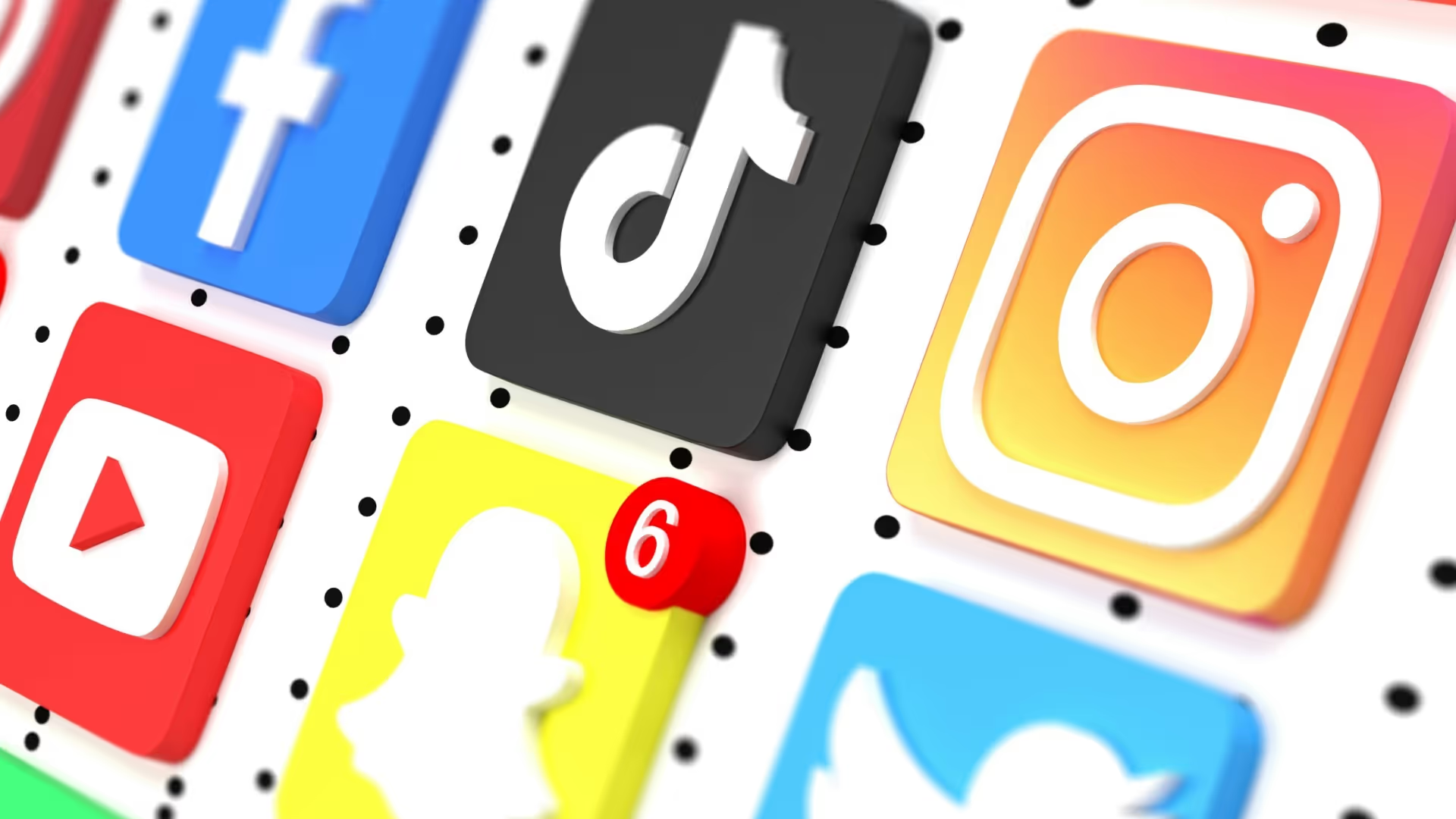
The school districts argue that these design choices made it harder for teachers to keep students focused. As Previn Warren, one of the lead attorneys for the schools, puts it, the platforms are “constantly tempting” students with “endless, infinite, varied entertainment” that competes directly with classroom learning.
TikTok: According to reporting in The New York Times, internal company documents cited in the school district lawsuits state that TikTok leadership chose not to turn off push notifications during school hours, despite long-standing recommendations from its safety teams.
I hate hearing that safety teams are ignored! And don’t get me started on the fact that the size of safety teams at all these companies has been drastically cut over the years. Argh, NOT expanded BUT cut.
Meanwhile, TikTok gave the National PTA millions of dollars to host school events on online safety. It has also been found that there was some sort of contingent funding tied to giving positive comments to journalists about TikTok.


Learn more about showing our movies in your school or community!
Join Screenagers filmmaker Delaney Ruston MD for our latest Podcast

Learn more about our Screen-Free Sleep campaign at the website!
Our movie made for parents and educators of younger kids
Learn more about showing our movies in your school or community!
Register your interest in bringing our new movie to your school or community
Snapchat: Snapchat sent phone alerts to teens DURING school, asking them to share what was going on in their classes. Can you believe it?!
Snapchat materials described classroom phone use as “under the desk” time, which is sadly so true. I can’t tell you how many students over the years have told me about all the students secretly using their phones under their desks.
Meta paid “teen ambassadors” to promote Instagram and hand out swag to their friends at school.
Google’s YouTube. Internal documents show that its own education team told higher-ups that the algorithm frequently fed students videos unrelated to what they were working on in school.
Google has been wooing schools since the beginning. In 2013, I experienced that firsthand when Google came to my kid’s school and did a dog-and-pony show.
These examples, such as this one, are based on evidence provided by plaintiffs in the case.
Lauren Hale, a leader in sleep research and public health who was featured in Screenagers Elementary School Age Edition, has been studying phone use in schools. Last year, she reported findings from a study she conducted with her team, in which they recruited teens aged 13–18 to install a monitoring app on their phones to track real-world smartphone use during school hours.
They found that adolescents spent about 1.5 hours of a 6.5-hour school day on their phones, nearly a quarter of the school day! And of course, much of that time was spent on social media use.
The good news is that all the people working to have Away For The Day phone policies in schools are making a difference. School after school are adopting such policies. We are making progress, but there is still much to be done.
Having regulations on social media companies is greatly needed to prevent the sort of things we are uncovering over all these years. So much harm and still no regulations. But I believe in our collective will and the science that supports us, to make the regulations happen.
Learn more about showing our movies in your school or community!
Join Screenagers filmmaker Delaney Ruston MD for our latest Podcast
Learn more about our Screen-Free Sleep campaign at the website!
Our movie made for parents and educators of younger kids
Join Screenagers filmmaker Delaney Ruston MD for our latest Podcast
Register your interest in bringing our new movie to your school or community
Subscribe to our YouTube Channel! We add new videos regularly and you'll find over 100 videos covering parenting advice, guidance, podcasts, movie clips and more. Here's our most recent:

As we’re about to celebrate 10 years of Screenagers, we want to hear what’s been most helpful and what you’d like to see next.
Please click here to share your thoughts with us in our community survey. It only takes 5–10 minutes, and everyone who completes it will be entered to win one of five $50 Amazon vouchers.
You may have heard that the first of more than a thousand school district lawsuits has just been settled. The settlement took place in Kentucky, where a very small school district was awarded $27 million. The four major defendants, YouTube, Snapchat, Meta, and TikTok, have all reached settlements.
Today, I write about some of the egregious revelations coming from the lawsuit discovery. It is upsetting. I am not surprised to be receiving emails from parents who feel “rage” at the companies as they learn what is coming out.
In many legal settlements, the public never sees what is uncovered during discovery. Discovery involves reviewing internal emails, company records, and deposition testimony, including interviews with employees, executives, and other key figures.
However, these settlements are different. Because the case involves a public school district, much of what was uncovered during discovery has been made available to the public.
The school districts argue that these design choices made it harder for teachers to keep students focused. As Previn Warren, one of the lead attorneys for the schools, puts it, the platforms are “constantly tempting” students with “endless, infinite, varied entertainment” that competes directly with classroom learning.
TikTok: According to reporting in The New York Times, internal company documents cited in the school district lawsuits state that TikTok leadership chose not to turn off push notifications during school hours, despite long-standing recommendations from its safety teams.
I hate hearing that safety teams are ignored! And don’t get me started on the fact that the size of safety teams at all these companies has been drastically cut over the years. Argh, NOT expanded BUT cut.
Meanwhile, TikTok gave the National PTA millions of dollars to host school events on online safety. It has also been found that there was some sort of contingent funding tied to giving positive comments to journalists about TikTok.
Snapchat: Snapchat sent phone alerts to teens DURING school, asking them to share what was going on in their classes. Can you believe it?!
Snapchat materials described classroom phone use as “under the desk” time, which is sadly so true. I can’t tell you how many students over the years have told me about all the students secretly using their phones under their desks.
Meta paid “teen ambassadors” to promote Instagram and hand out swag to their friends at school.
Google’s YouTube. Internal documents show that its own education team told higher-ups that the algorithm frequently fed students videos unrelated to what they were working on in school.
Google has been wooing schools since the beginning. In 2013, I experienced that firsthand when Google came to my kid’s school and did a dog-and-pony show.
These examples, such as this one, are based on evidence provided by plaintiffs in the case.
Lauren Hale, a leader in sleep research and public health who was featured in Screenagers Elementary School Age Edition, has been studying phone use in schools. Last year, she reported findings from a study she conducted with her team, in which they recruited teens aged 13–18 to install a monitoring app on their phones to track real-world smartphone use during school hours.
They found that adolescents spent about 1.5 hours of a 6.5-hour school day on their phones, nearly a quarter of the school day! And of course, much of that time was spent on social media use.
The good news is that all the people working to have Away For The Day phone policies in schools are making a difference. School after school are adopting such policies. We are making progress, but there is still much to be done.
Having regulations on social media companies is greatly needed to prevent the sort of things we are uncovering over all these years. So much harm and still no regulations. But I believe in our collective will and the science that supports us, to make the regulations happen.
Subscribe to our YouTube Channel! We add new videos regularly and you'll find over 100 videos covering parenting advice, guidance, podcasts, movie clips and more. Here's our most recent:
Sign up here to receive the weekly Tech Talk Tuesdays newsletter from Screenagers filmmaker Delaney Ruston MD.
We respect your privacy.
You may have heard that the first of more than a thousand school district lawsuits has just been settled. The settlement took place in Kentucky, where a very small school district was awarded $27 million. The four major defendants, YouTube, Snapchat, Meta, and TikTok, have all reached settlements.
Today, I write about some of the egregious revelations coming from the lawsuit discovery. It is upsetting. I am not surprised to be receiving emails from parents who feel “rage” at the companies as they learn what is coming out.
In many legal settlements, the public never sees what is uncovered during discovery. Discovery involves reviewing internal emails, company records, and deposition testimony, including interviews with employees, executives, and other key figures.
However, these settlements are different. Because the case involves a public school district, much of what was uncovered during discovery has been made available to the public.
The school districts argue that these design choices made it harder for teachers to keep students focused. As Previn Warren, one of the lead attorneys for the schools, puts it, the platforms are “constantly tempting” students with “endless, infinite, varied entertainment” that competes directly with classroom learning.
TikTok: According to reporting in The New York Times, internal company documents cited in the school district lawsuits state that TikTok leadership chose not to turn off push notifications during school hours, despite long-standing recommendations from its safety teams.
I hate hearing that safety teams are ignored! And don’t get me started on the fact that the size of safety teams at all these companies has been drastically cut over the years. Argh, NOT expanded BUT cut.
Meanwhile, TikTok gave the National PTA millions of dollars to host school events on online safety. It has also been found that there was some sort of contingent funding tied to giving positive comments to journalists about TikTok.
Meta's $17.1 billion settlement requires new safety measures for under-18 users, including a two-hour daily limit and blocking Instagram and Facebook overnight. I'm frustrated it took this long, and that an overnight block can falsely reassure parents when what we really need is a national push for screen-free sleep. I'm glad it happened. And with AI, we have to move much faster.
READ MORE >
The first of 1,200+ school district lawsuits against social media companies just settled, with Meta, YouTube, Snap, and TikTok all paying out rather than face a jury. Meta points to its Teen Accounts feature as proof of safety, but a study by former Meta safety lead Arturo Bejar found only 8 of 47 advertised features actually work as described.
READ MORE >
Teen psychologist Lisa Damour breaks down three manipulative tactics online games and apps use to push kids into spending: algorithms that time pitches to when kids are tired or bored, scarcity tactics like countdown timers that trigger impulse buys, and in-app currencies (gems, coins, tokens) designed to disguise real dollar costs. Research shows teens resist these tactics better once they understand them.
READ MORE >for more like this, DR. DELANEY RUSTON'S NEW BOOK, PARENTING IN THE SCREEN AGE, IS THE DEFINITIVE GUIDE FOR TODAY’S PARENTS. WITH INSIGHTS ON SCREEN TIME FROM RESEARCHERS, INPUT FROM KIDS & TEENS, THIS BOOK IS PACKED WITH SOLUTIONS FOR HOW TO START AND SUSTAIN PRODUCTIVE FAMILY TALKS ABOUT TECHNOLOGY AND IT’S IMPACT ON OUR MENTAL WELLBEING.